
In the Chinese microcontroller market, STC holds a unique position. It does not compete on ecosystem or toolchains; it wins on extreme cost-performance, in-circuit programming over a simple serial cable, strong noise immunity and code that cannot be read back. These four traits have kept it in service for decades across industrial control, consumer electronics, teaching labs and automation retrofits. Based on the 50 parts being quoted most this week, this article explains STC's series evolution, part-number decoding and selection logic in one pass.
STC is the enhanced 8051 microcontroller brand of 宏晶科技 (STCmicro Technology Co., Ltd.), which positions itself as the standard-setter for next-generation enhanced 8051 MCUs, with a nationwide sales network and a reputation for extremely low prices plus complete support.
The technical core of STC MCUs can be summarized in a few points: instruction-set compatibility with the classic 8051, but a 1T (single clock/machine-cycle) architecture that runs 8 to 12 times faster than traditional 8051; a built-in high-precision R/C clock, so most parts need no external crystal; ISP/IAP in-system programming that downloads code over a UART without a programmer; large on-chip Flash, SRAM and Data Flash (usable as EEPROM); ninth-generation encryption claimed to be undecryptable — a practical defense against board cloning; wide supply voltage, low power, strong anti-interference, and industrial temperature grades.
STC's lineup advances generation by generation, each keeping the 8051 instruction set while upgrading speed and resources:
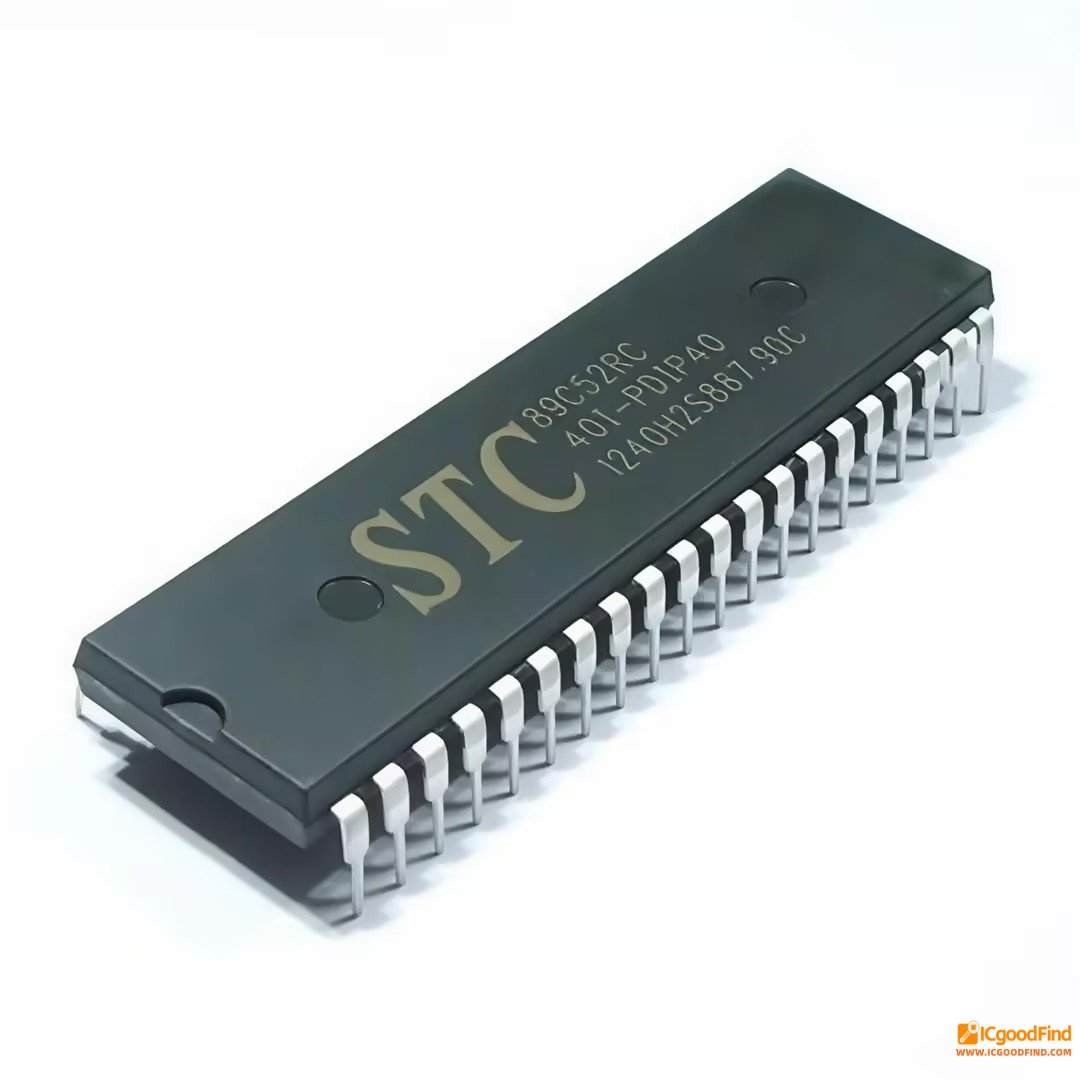
STC89C52RC-40I-PDIP40, STC89C52RC-40I-LQFP44, STC89C58RD+40I-LQFP44, STC89C58RD+40I-PDIP40.
Two Flash tiers (8 KB for the 52RC, 32 KB for the 58RD+), 40 MHz, industrial grade. PDIP40 through-hole suits breadboards and relay control; LQFP44 surface-mount suits production boards.
STC12C5A60S2-35I-LQFP44, STC12C5A60S2-35I-PDIP40, STC12C5A60S2-35I-LQFP48, STC12C5A60S2-35I-LQFP44-LQFP48-PDIP-PLCC, STC12C5A60S2, STC12C5A32S2-35I-LQFP44, STC12C5A16S2-35I-LQFP44, STC12LE5A60S2-35I-LQFP44, STC12C5608AD-35I-LQFP32, STC12C5616AD-35I-LQFP32, STC10F08XE-35I-LQFP44.
STC12C5A60S2 is the all-purpose part — 60 KB Flash, dual UART, 10-bit ADC — available across LQFP44/48, PDIP40 and PLCC44, so second-source buyers simply pick the package that matches the board. The 5608AD/5616AD are the LQFP32 small-package versions with ADC; the LE suffix marks the 2.2 V to 3.6 V low-voltage version.
STC15W408AS-35I-SOP16, STC15W408AS-35I-SOP20, STC15W408AS-35I-SOP28, STC15W408AS-35I-TSSOP20, STC15W408AS-35I-TSSOP28, STC15W408AS, STC15W204S-35I-SOP16, STC15W204S-35I-SOP8, STC15W201S-35I-SOP8, STC15W201S-35I-SOP16, STC15W202S-35I-SOP16, STC15W104-35I-SOP8, STC15W404AS-35I-SOP16, STC15F104W-35I-SOP8, STC15F104E-35I-SOP8, STC15W4K32S4-30I-LQFP44, STC15W4K56S4-30I-LQFP44, STC15F2K60S2-28I-LQFP44, STC15F2K60S2-28I-LQFP32, STC15F2K60S2.
This is the hottest-quoted bucket: the small packages (SOP8/SOP16) with 104/201S/204S/408AS fit sensor acquisition, small appliances and power-tool control boards; the large-capacity 4K32S4/4K56S4/F2K60S2 parts with 4 or 2 UARTs suit multi-UART communication, instrumentation and inverter applications.
STC8G1K08A-36I-SOP8, STC8G1K08-36I-SOP8, STC8G1K08-38I-TSSOP20, STC8G1K08-38I-SOP16, STC8G1K17-38I-TSSOP20, STC8H1K08-36I-TSSOP20, STC8H1K16-36I-LQFP32, STC8H1K17-36I-TSSOP20, STC8H1K28-36I-LQFP32, STC8A8K64S4A12-28I-LQFP44, STC8A8K64S4A12-28I-LQFP48, STC8A8K64S4A12-28I-LQFP64, STC8A8K64D4-45I-LQFP48, STC8A8K64D4-45I-LQFP64, STC8G2K64S4-36I-LQFP48.
The G series targets 1.9 V to 5.5 V wide voltage and low power; the small packages fit battery-powered products. The H series is the high-speed version with a higher clock at the same resource level. The flagship is STC8A8K64S4A12 — 8 KB SRAM, 64 KB Flash, 4 UARTs, 12-bit ADC — available in LQFP44/48/64, suitable for industrial mainboards, multi-machine communication and larger projects with analog acquisition.
With four generations (89/12/15/8), STC has taken "low-cost enhanced 8051" to the extreme: instruction compatibility, serial download, read-out protection, wide voltage and strong noise immunity, at a very low unit price. The 50 hot models listed above — STC89C52RC, STC12C5A60S2, the STC15W family and the STC8G/8H/8A families — cover everything from entry-level learning to 64 KB high-resource industrial applications. All are available with genuine stock and stable supply channels at ICGOODFIND (#ICGOODFIND), supporting sample orders, full-reel pricing and same-model multi-package alternative checks — send the part number to confirm inventory quickly.
